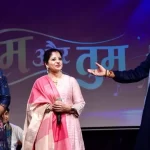
Devanand Jha and Shweta Dubey mesmerise audiences with timeless melodies as Triveni Auditorium resonates with applause
New Delhi(Reporter: Pradeep Kumar; Editor: Namya Pandey): Some songs are not merely heard; they bring alive beautiful moments, unfulfilled desires and memories tucked away in the heart. Evening of 22 Oct 2026 at Triveni Auditorium in New Delhi was one such occasion, as Hum Aur Tum, a musical presentation celebrating the many shades of love, separation, playful disagreements and reconciliation, took the audience on an emotional journey through timeless Hindi film music.
The packed auditorium echoed with applause after every song. The audience was seen smiling, reminiscing, becoming emotional and occasionally humming along as familiar melodies rekindled cherished memories.
All India Radio A-grade artists Devanand Jha and Shweta Dubey lent their melodious voices to evergreen Hindi film songs, presenting them with renewed emotion and freshness. Beginning with ‘Naam Gum Jayega’ and moving through ‘Rahein Na Rahein Hum’, the musical journey gradually explored the many moods of romance, from heartfelt confessions and tender longing to playful sulking and affectionate attempts at reconciliation. The evening eventually reached ‘Tujh Mein Rab Dikhta Hai’, celebrating love in its most beautiful form, when one begins to see the divine in the beloved.
The presentation featured memorable songs from Hindi cinema that have continued to rule hearts across generations. Melodies such as ‘Humein Tumse Pyar Kitna’, ‘Bahut Pyar Karte Hain Tumko Sanam’, ‘Jiyen To Jiyen Kaise Bin Aapke’, ‘Dil Hai Ki Manta Nahin’, ‘Aaye Ho Meri Zindagi Mein Tum Bahaar Banke’ and ‘Main Tenu Samjhawan Ki’ gave voice to different shades of love and longing.
Songs such as ‘Aji Rooth Kar Ab Kahan Jaiyega’ and ‘Aji Humse Bachkar Kahan Jaiyega’ brought a playful charm to the evening, filling the auditorium with smiles and adding a delightful touch of flirtation to the musical narrative.
The programme, however, went beyond romantic melodies. Songs such as ‘Mere Naina Sawan Bhadon Phir Bhi Mera Mann Pyasa’, ‘Tujhse Naraz Nahin Zindagi Hairan Hoon Main’, ‘Humein Aur Jeene Ki Chahat Na Hoti Agar Tum Na Hote’ and ‘O Saathi Re Tere Bina Bhi Kya Jeena’ explored life’s melancholy, its hopes and the emotional depth of human relationships.
Other memorable numbers, including ‘Na Tum Humein Jaano’, ‘Tu Is Tarah Se’, ‘Tu Hi To Jannat Meri’ and ‘Tum Mujhe Yun Bhula Na Paoge’, transported listeners into a world of nostalgia. The sentiment expressed in ‘Tum Mujhe Yun Bhula Na Paoge, Jab Kabhi Bhi Sunoge Geet Mere, Sang-Sang Tum Bhi Gungunaoge’ seemed to capture the essence of the entire evening: songs may end, but their memories continue to live on.
The presentation was conceptualised and written by Nidhikant Pandey, who also served as its narrator and host. Its defining tagline, “Ek Geet Do Andaaz” (One Song, Two Styles), shaped the musical selection. The programme featured songs that appeared more than once in a film, sometimes in different voices and sometimes in distinct musical interpretations.
This format allowed the audience to discover familiar songs from fresh perspectives. Their enthusiastic responses ranged from appreciative applause and expressions of admiration to moments of quiet emotion. The interplay between music, storytelling and audience participation gave the evening its distinctive character.
The musical arrangements were strengthened by the contributions of Adhir, Amit and Jeetu, while Rajneesh Gautam handled the lighting.
Presented by Three Arts Club and Katyayani, the programme also stood out for its distinctive visual theme. The idea of dressing the evening in pink and blue was conceived by Anuradha Dar, who brought the concept to life with the support of Avinash Singh, Kamlesh and Rajneesh. The thoughtful use of colour added to the warmth and visual appeal of the occasion. Anuradha Dar and Sohaila Kapoor produced the presentation.
One of the most endearing aspects of Hum Aur Tum was that it emerged as much more than a musical show. It became a shared celebration of relationships, memories and the emotions that connect people across generations. Each song seemed to tell a personal story: a first love remembered, a companion missed or a cherished moment that grows more precious with time.
Nidhikant Pandey kept the proceedings lively and engaging with his distinctive style of narration. Anecdotes, stories and historical insights related to the songs added depth to the presentation. The interactive segments, particularly questions about the songs and the audience’s enthusiastic participation in answering them, made the programme even more vibrant.
As the musical journey drew to a close, the farewell came with a promise of another rendezvous: a return on the fourth Thursday of the following month. The message was simple yet heartfelt. Life would continue to bring its share of ups and downs, and time would keep changing, but the caravan of love, music and memories would move on.
Ultimately, Hum Aur Tum was not merely the name of a programme; it was an expression of the bond that brings two hearts together. Songs may end and evenings may fade, but the melodies that linger within us continue to tell their own story.
And as the audience departed with those melodies in their hearts, one sentiment remained: the journey of love and music is far from over.
- ‘Hum Aur Tum’: A Musical Journey Through Love, Longing and the Beautiful Shades of Life
- JMI Teaching, Non-Teaching Staff Condemn ‘Objectionable Slogans’; University Shifts Classes Online

- Sadguru Shri Uday Singh Ji Maharaj Visits Ajmer Sharif Dargah, Receives Global Peace Award from Haji Syed Salman Chishty

- JMI Constitutes Committee to Draft Constitution of Jamia Millia Islamia Students’ Union
- JMI Forms 7-Member Panel to Engage Protesting Students and Restore Campus Calm