
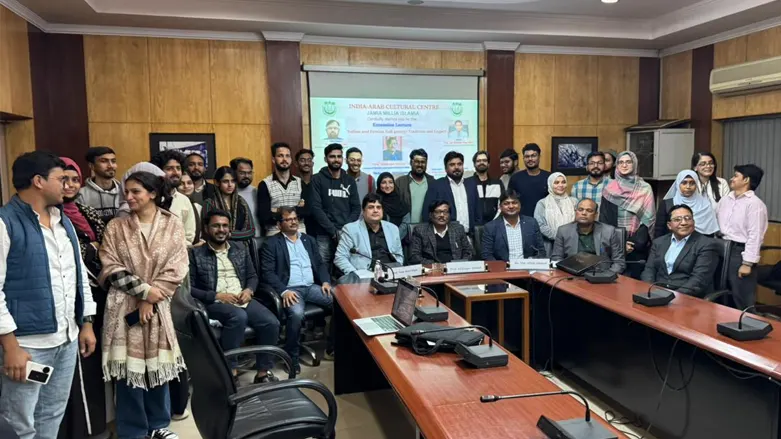
New Delhi, November 28, 2025: The India-Arab Cultural Centre at Jamia Millia Islamia organised an extension lecture on November 26, 2025, titled “Sufism and Persian Poetry: Tradition and Legacy”. Professor Akhlaque Ahmad Ahan, Chairperson of the Centre for Persian and Central Asian Studies, School of Language, Literature and Culture Studies at Jawaharlal Nehru University, delivered the lecture. Professor Nasir Raza Khan, Honorary Director of the Centre, chaired the event, which attracted a diverse audience keen to explore the profound connections between Sufism and Persian poetry.
Opening Remarks
Prof. Nasir Raza Khan thanked the Vice Chancellor of Jamia Millia Islamia, Prof. Mazhar Asif, for granting permission to organise the extension lecture series. He also acknowledged the university’s Registrar, Prof. Md. Mahtab Alam Rizvi, for his support. Prof. Khan introduced the theme by highlighting the significance of Sufism and Persian poetry in promoting multiculturalism and identity. He discussed how the modern world requires the healing message found in Rumi’s poetry, which advocates for compassion beyond identity.youtube
Speaker Introduction
Dr. Md. Aftab Ahmad formally introduced the speaker and contextualised the topic’s importance within contemporary socio-intellectual discourse. He discussed Professor Ahan’s expertise and contributions as a renowned scholar of Sufism, Persian literature, and Islamic intellectual traditions.jnu
Lecture Highlights
Professor Ahan presented a comprehensive exposition on the historical evolution, philosophical grounding, and literary manifestations of Sufism, with particular emphasis on Persian poetic traditions. He began by discussing the etymology of the word Tasawwuf, highlighting various scholarly interpretations. The term ‘Sufi’ has been associated with multiple roots: Suffah (referring to Ashab-e-Suffah, devoted companions of the Prophet who lived near Masjid-e-Nabawi and embodied simplicity and spiritual dedication), Safa (purity of heart), and Suf (wool, alluding to the simple woollen garments worn by early Sufis).
Professor Ahan explored how Sufism gradually transformed from an individual spiritual tendency into an ideological and organised movement, particularly in Mecca and Medina. He elaborated on the intellectual and spiritual frameworks through which Sufis have historically approached the concept of God, making references to Hegel’s engagement with Oriental notions of divinity and Marx’s reversal of Hegelian ideas.
Sufi Traditions and Classifications
The speaker drew upon the teachings of Hazrat Sharafuddin Ahmed Yahya Maneri, a major Sufi saint from Bihar Sharif. In Maktubat-i-Sadi, Maneri identifies three categories of belief regarding God: munkir (those who deny God), munafiqin (those who outwardly exhibit belief but lack genuine conviction), and those who realise God through deep spiritual experience.
Professor Ahan highlighted the profound transformation in Islamic intellectual and cultural life following the Mongol destruction of Baghdad. The unprecedented devastation triggered significant migration to India, especially to rural regions, during which major Sufi orders such as the Chishtiyya and Naqshbandiyya flourished. Persian literary traditions shifted dramatically, moving from Hamasah (epic poetry) and Qasida to the Ghazal, now centered on themes of Ishq (divine love) and self-realisation. Poets like Rumi, Sa’di, and Hafiz became central figures in articulating Sufi ideas.
Interactive Session
The lecture was followed by a lively question-and-answer session, with both students and faculty actively engaging with the speaker on Sufi philosophy, Persian literary traditions, and the contemporary relevance of mystical thought. The programme concluded with a formal vote of thanks delivered by Dr. Zulfikar Ali Ansari, who acknowledged the speaker, chair, organisers, and participants for their meaningful contributions to the intellectually enriching event.
- NIA Raids Anantnag Resident’s Home in Terror Probe; Mobile Phone Confiscated

- Kupwara Man Chargesheeted by Kashmir EOW in J&K Bank Job Scam

- JMI Kickstarts Placement Season 2027: 34 Students Placed at TCS
- Jamia Millia Islamia’s CDOE Extends Admission Deadline to Sept 8, Launches 11 New Courses
- J&K Police Issue August 5 Security Advisory, Strictly Restrict Unpermitted Rallies