New Delhi (Pradeep Kumar): Life is a fascinating blend of happiness and sorrow, hope and despair, struggle and success. Sorrow does not merely teach us to endure; it teaches us to smile through difficult circumstances, while hardships remind us that no night lasts forever. Difficult phases, too, shall pass. It was this philosophy of life that came alive through music, songs and storytelling in ‘Dastaan-e-Khushi’, where the joys associated with different stages of life took the audience on an emotional journey, with every song revealing a new meaning of life.
Presented by Three Arts Club and Katyayani in collaboration with Triveni Kala Sangam, the special musical presentation was held on the evening of 24 September 2026 at Triveni Auditorium, which was packed with music lovers and art enthusiasts.
Nidhikant Pandey, the writer, director and presenter, gave the programme its distinctive emotional and philosophical character through his engaging presentation. The musical voice of the evening was Devanand Jha, an ‘A’ Grade artist of All India Radio. The music was handled by Adhir Das, Jeetu Nadaan and Amit Kumar, while Rajneesh Gautam was in charge of lighting. Sohaila Kapur and Anuradha Dar were the producers. Anuradha Dar, Rajneesh Gautam and Avinash Singh were responsible for the stage design.
The programme opened with the soulful song ‘Jab Deep Jale Aana’ and gradually moved through a musical journey encompassing childhood, youth, struggle, hope, love, success and a positive outlook towards life. ‘Ruk Jaana Nahin’ conveyed the message of moving forward despite adversity, while ‘Zindagi Kaisi Hai Paheli’ and ‘Har Ghadi Badal Rahi Hai Roop Zindagi’ reflected the ever-changing nature of life.
The message was clear: circumstances are never permanent, and therefore, one difficult phase should never be mistaken for the whole of life.
Songs such as ‘Aane Wala Pal Jaane Wala Hai’ and ‘Yahaan Ke Hum Sikandar’, along with Nidhikant Pandey’s presentations, underlined the passage of time and the spirit of resilience. Meanwhile, ‘Bachpan To Gaya, Jawani Bhi Gayi, Ek Pal To Ab Humein Jeene Do, Jeene Do’ reminded the audience of the importance of living in the present moment as time continues to move on.
The pairing of storyteller Nidhikant Pandey and singer Devanand Jha has also been receiving considerable appreciation in recent times. Over the past year, the duo has presented several successful shows, including multiple performances of some productions. Among them are ‘Dastaan-e-Dev Anand’, ‘Pal-Pal Dil Ke Paas Tum Rahte Ho: Dharmendra’, ‘Dastaan-e-Barsaat’, ‘Geeton Mein Bharat’ and ‘Dastaan-e-Mukesh’. With ‘Dastaan-e-Khushi’, the duo has added another successful production to this continuing musical journey, and the show is being described by many audience members as one of their most memorable collaborations so far. The combination of Pandey’s storytelling, through which songs are woven into stories and emotions, and Jha’s distinctive voice has found a warm response among audiences.
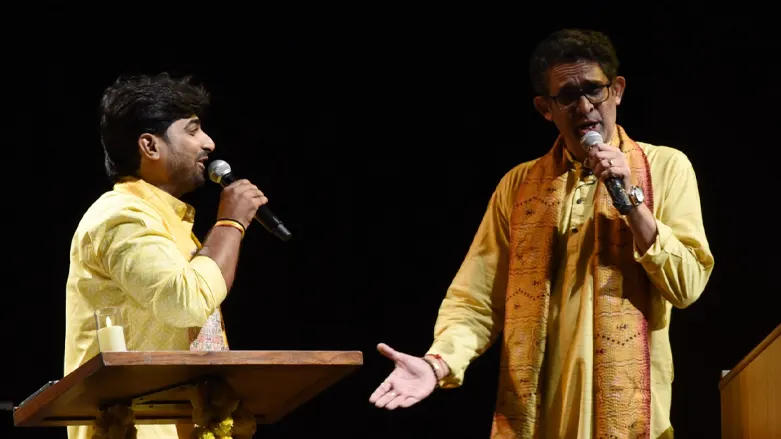
The most distinctive feature of ‘Dastaan-e-Khushi’ was its interpretation of happiness not merely as laughter or entertainment, but as a way of looking at life that emerges after passing through struggles. Songs such as ‘Itti Si Hansi, Itti Si Khushi’, ‘Aashayein Aashayein’, ‘Yun Hi Chala Chal Rahi’ and ‘Love You Zindagi’ presented small moments of joy as some of life’s greatest treasures. The auditorium came alive during ‘Love You Zindagi’, as mobile phone flashlights swayed in the air, with the audience humming along and waving their hands to the rhythm of the music.
Nidhikant Pandey’s presentations added greater depth to the philosophical dimension of the programme. The sentiment of ‘Rote Rote Hansna Seekho’, in his voice, seemed to capture the essence of the entire presentation: not to run away from sorrow, but to accept life even in the midst of it. In the same vein, ‘Zindagi Ki Yahi Reet Hai, Haar Ke Baad Hi Jeet Hai’ underlined the enduring relationship between struggle and success.
The programme also explored the colours of love, belonging and human sensitivity. ‘Kisi Ki Muskurahaton Pe Ho Nisaar’ conveyed the message of finding one’s own happiness in the happiness of others. At this point, ‘Dastaan-e-Khushi’ moved beyond personal joy to become a celebration of human values and shared happiness.
Towards the finale, songs such as ‘Chhoti Chhoti Khushiyan’ and ‘Uthe Sabke Kadam… Aji Aise Geet Gaya Karo’ transformed the auditorium into a celebration of joy. The audience swayed to the rhythm and melodies, and the enthusiasm continued even after the formal conclusion of the programme. Responding to the audience’s demand, ‘Har Ghadi Badal Rahi Hai Roop Zindagi’ was performed once again.
In essence, ‘Dastaan-e-Khushi’ was not merely a programme of songs; it was a positive philosophy of looking at life. The message was simple yet profound: sorrow is a phase of life, not its destination; difficulties are obstacles along the way, not the end of the road. If there are tears in our eyes today, there will be smiles tomorrow. True happiness lies in accepting life in all its colours and learning to cherish its small, everyday moments of joy.
And that is perhaps why, as the audience left Triveni Auditorium, they carried back not merely the melodies of the evening, but also a renewed sense of hope: life changes its form every moment, and therefore every moment deserves to be lived to the fullest.
- Dastaan-e-Khushi: Every Note of Life Holds a Reason to Smile
- Jamia Millia Islamia Signs MoUs with Top Life Sciences Firms for NEP-Aligned Research

- Two Musical Dastaan Performances, Three Shows at Rajasthan International Centre
- IndiGo Flight Hits VDGS Pole While Parking at Srinagar Airport; All Passengers and Crew Safe

- Over 150,000 Attendees Gather for 18th International Sufi Rang Festival at Ajmer Sharif

- Dastan-e-Mukesh: Jag me reh gaye pyare tere Bol