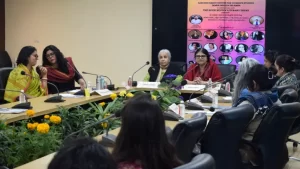
Former Patna High Court Chief Justice delivers scathing critique of constitutional erosion at Rule of Law Conclave, urging citizens to defend democracy against authoritarian impulses
New Delhi: A clarion call to defend India’s constitutional democracy echoed through Jawar Bhawan on Sunday as leading legal experts, activists, and scholars gathered for the Indian Muslims for Civil Rights (IMCR) Rule of Law Conclave. The event’s most striking moment came when former Patna High Court Chief Justice Iqbal Ansari delivered a powerful reminder: “A government is not the nation; the real battle is to preserve the nation’s independence from oppression.”
The conclave brought together prominent voices from India’s legal fraternity to address mounting concerns over constitutional governance, judicial independence, and the criminalization of democratic dissent.
IMCR’s Mission Beyond Community Lines
Opening the proceedings, IMCR Chairman Mohammad Adeeb traced the organization’s roots to visionary leaders including Salman Qureshi, Farooq Abdullah, Rahman Khan, and Syeda Hamid. “We did not create IMCR only for Muslims, but for Hindus, Sikhs, Christians, and all who suffer injustice,” Adeeb declared, emphasizing the organization’s commitment to protecting all marginalized communities.
Adeeb urged legal professionals to take proactive action by filing FIRs against hate speech rather than remaining passive observers. He warned that without united resistance across communities, the damage to India’s secular fabric could take “generations to repair.”
The Erosion of Rule of Law
Former Union Minister Salman Khurshid highlighted fundamental principles of fair governance, arguing that “bail should be the norm, jail the exception.” Citing prolonged pre-trial detentions under controversial laws like CAA and NRC, he emphasized that “no amount of compensation can replace lost years of life.”
On religious freedom issues like the hijab controversy, Khurshid insisted that only religious scholars can determine essential practices, cautioning that legal rulings without justice remain meaningless.
Dissent: From Democratic Right to Criminal Act
Delhi University professor Apoorvanand delivered perhaps the most crucial intervention, focusing on how legitimate democratic opposition has been systematically criminalized. “What was once a legitimate democratic act, questioning laws, has now been twisted into a crime,” he argued, pointing to how opposition to the Citizenship Amendment Act was branded as conspiracy and anti-national activity.
Apoorvanand praised India’s Muslim community for maintaining unwavering faith in constitutional remedies despite facing systemic hostility. From Zakia Jafri’s relentless legal battle after the 2002 Gujarat violence to families of mob-lynching victims continuing their fight for justice, he highlighted the community’s commitment to constitutional processes.
“When citizens begin to predict justice based on the bench rather than the law, it is a sign of deep erosion of the rule of law,” he warned, stressing that courts must restore public faith in impartial justice.
Justice Ansari’s Judicial Critique
The conclave’s highlight was Justice Ansari’s candid assessment of India’s current judicial landscape. Drawing from childhood memories of interfaith harmony, he lamented the loss of mutual respect in contemporary India before delivering sharp criticism of the judiciary itself.
Ansari criticized courts for “privileging popularity and spectacle over justice,” referencing controversial verdicts that have blurred public perceptions of lawful decisions versus actual justice. He particularly condemned the misuse of stringent laws like UAPA, warning that detaining citizens without timely trials violates fundamental rights to speedy justice.
Addressing cases like that of activist Umar Khalid, Ansari emphasized these are “not community issues but struggles to safeguard Indian democracy itself.” His central message resonated throughout: “The nation’s independence cannot be surrendered to authoritarian impulses.”
Legal Interventions and Constitutional Threats
Supreme Court advocate Fuzail Ayyubi detailed IMCR’s ongoing legal battles, including their challenge to the Maulana Azad Educational Foundation’s closure and successful compensation case for Noor, whose home was unlawfully demolished.
Ayyubi highlighted growing constitutional threats in states like Assam and Uttarakhand, pointing to selective demolitions and restrictive education policies. “Protecting the Constitution and Hindu-Muslim unity are inseparable,” he declared, “for any attack on these principles weakens both democracy and social harmony.”
Historical Lessons for Modern Justice
Concluding the session, Maulana Fazlur Mujdadi invoked early Islamic history, recounting how Caliph Hazrat Umar accepted a judicial verdict against himself, demonstrating true governmental accountability. “The strength of a judiciary lies not in serving the powerful but in protecting the powerless,” he reminded the gathering.
A Constitutional Wake-Up Call
The conclave, conducted by Akansha Ray and featuring contributions from legal luminaries including Sanjay Hegde, Mehdi Rizvi, Anas Tanveer, and others, was more than a critique—it served as both warning and inspiration. Former National Water Commission Chairman Syed Masood Hussain summarized the proceedings as “a powerful call to defend the Constitution.”
At a time when democratic institutions face unprecedented pressures, Justice Ansari’s words—“a government is not the nation”—and Apoorvanand’s reminder that opposing unjust laws is not criminal reverberated as urgent calls to action. The conclave underscored a fundamental truth: the health of India’s democracy depends on a fearless judiciary, active citizenry, and unwavering commitment to constitutional values.
The message was clear—protecting constitutional democracy requires collective vigilance against any force that seeks to blur the line between government and nation, ensuring that dissent remains a democratic right rather than a criminal offense.
- Jamia’s RCA Shines: 38 Students Clear UPSC 2025 with 4 in Top 50
- JIH President Condemns US-Israel Aggression on Iran, Warns Against Wider Gulf War

- Srinagar Police Launch Major Crackdown on Fake News Network; Multiple Summons Issued

- JIH President Syed Sadatullah Husaini Mourns Ayatollah Ali Khamenei Assassination, Blasts US-Israel Strikes on Iran
- Jamia Millia Islamia Partners with Argentina’s UNSAdA to Bolster Global Academic Research
- JIH Chief Condemns US-Israel Strikes on Iran, Warns of Regional War
- JIH President Expresses Deep Concern Over PM’s Israel Visit Amidst Gaza Humanitarian Crisis
- Rising Numbers of Missing Women in India: JIH National Secretary Calls for Urgent Action

- Jamia: Syed Abid School Bags ‘Best Performing Award’ in Delhi Urdu Academy Competitions
- President Droupadi Murmu to Embark on Four-Day Tour of Maharashtra, Jharkhand, and Rajasthan

- Delhi Shocker: 6-Year-Old Girl Kidnapped and Murdered by Relative in Sarai Kale Khan

- JMI Hosts National Symposium on Women in Literature and Translation