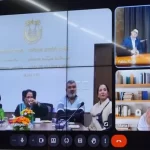
New Delhi, December 23, 2025: The India-Arab Cultural Centre (IACC), Jamia Millia Islamia (JMI), organized a two-day International Conference on “Sardar Vallabhbhai Patel: Life, Works and Indian Muslims” on December 22–23, 2025. The inaugural session was held on December 22 at 11:30 a.m. in the IACC Conference Hall.
The session began with the recitation of verses from the Holy Qur’an, followed by a welcome address by the Director of the Centre, Prof. Nasir Raza Khan, who greeted and introduced the guests. The event was graced by Prof. Mazhar Asif (Vice-Chancellor, JMI), Dr. Rizwan Kadri (Member, Prime Minister’s Museum & Library Society), Mr. Yahya Aldughaishi (Embassy of the Sultanate of Oman), Prof. Mohd. Muslim Khan (Dean, Faculty of Social Sciences, JMI), and Prof. Mohammad Sajjad (Department of History, AMU), along with faculty members and scholars from various universities.
In his address, Prof. Nasir Raza Khan highlighted the significance of the conference theme, emphasizing the need to examine Sardar Patel’s legacy and his relationship with Indian Muslims from a historical perspective. He expressed gratitude to Vice-Chancellor Prof. Mazhar Asif and Registrar Prof. (Dr.) Md. Mahtab Alam Rizvi for their support, and to the Indian Council of Historical Research (ICHR) for co-funding the event. Prof. Khan shared that Patel’s 1947 visit to the Nizamuddin Dargah during Partition inspired him to organize this conference, underscoring Patel’s efforts to protect cultural and religious harmony during a difficult period.
Mr. Yahya Aldughaishi, representing the Embassy of Oman, thanked the organizers and discussed Patel’s role in shaping India’s ties with the Arab world, particularly Oman. Prof. Mohd. Muslim Khan spoke about Sardar Patel’s unifying leadership during Partition and his association with Jamia Millia Islamia’s former Vice-Chancellor, Dr. Zakir Husain, through their joint participation in the Bardoli Movement. He recalled Patel’s visits to refugee camps and religious sites in Delhi, including Nizamuddin Dargah, where he urged authorities to protect all communities.
Delivering the keynote address, Dr. Rizwan Kadri shed light on lesser-known aspects of Patel’s life and called for deeper research into archival materials and vernacular sources. He mentioned Patel’s associations with figures like Maulana Ghulam Rasool (Imam Sahab) and Maulana Hasrat Mohani, and highlighted Patel’s spirit of forgiveness toward his critics.
In his presidential remarks, Prof. Mazhar Asif, the Vice-Chancellor, encouraged scholars to study Patel’s legacy through regional sources, especially Gujarati texts. He emphasized Patel’s role as India’s Home Minister during the Partition years and noted his contributions to promoting Urdu broadcasting and the launch of the Urdu magazine Aaj Kal. Quoting Madan Mohan Malviya, he reminded the audience that leaders like Sardar Patel and Maulana Azad should be remembered for their nation-building work beyond religious identities.
The session concluded with a formal vote of thanks delivered by Dr. Aftab Ahmed, Associate Professor at IACC. He expressed gratitude to all distinguished guests, speakers, and participants for making the conference a success.
- Jamia’s RCA Shines: 38 Students Clear UPSC 2025 with 4 in Top 50
- JIH President Condemns US-Israel Aggression on Iran, Warns Against Wider Gulf War

- Srinagar Police Launch Major Crackdown on Fake News Network; Multiple Summons Issued

- JIH President Syed Sadatullah Husaini Mourns Ayatollah Ali Khamenei Assassination, Blasts US-Israel Strikes on Iran
- Jamia Millia Islamia Partners with Argentina’s UNSAdA to Bolster Global Academic Research